
Armenian Alphabet
"The most perfect phonetic writing for its time"
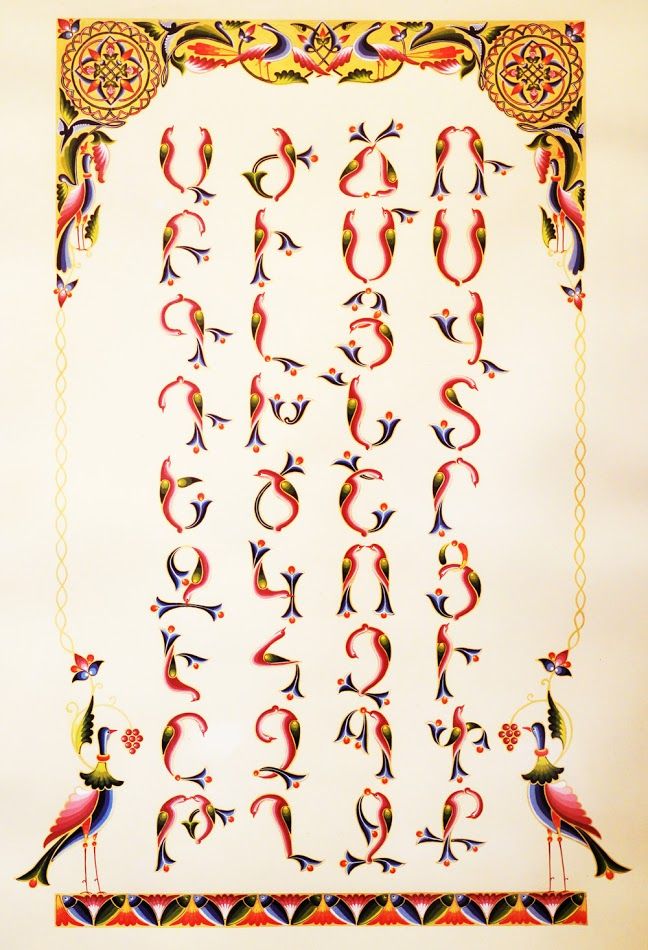
The Armenian alphabet was created in the year 405 AD by Mesrop Mashtots (also spelled Mesrop Maštocʿ), an Armenian monk, scholar, and linguist. He worked with the support of two important leaders: Catholicos Sahak Partev (Isaac the Great), head of the Armenian Church, and King Vramshapuh of Armenia.
This was a planned, scientific project to give the Armenian language its own writing system, so that religious texts, education, and administration could be done in Armenian instead of Greek or Syriac.
Why it was needed
Before 405, Armenians used foreign scripts (like Greek, Syriac, and older local systems) to write. After Armenia became Christian in 301 AD, the Church wanted to spread the faith in the people's own language, but there was no good alphabet for Armenian sounds.
Early attempts to adapt other alphabets failed because they could not represent Armenian speech accurately. So the king and church leaders asked Mesrop Mashtots to solve this problem.
How Mashtots created the alphabet
Mashtots did careful research before designing the letters:
- He traveled to major cultural centers, including Edessa, Samosata, and possibly Alexandria, to study different writing systems.
- He examined Greek, Syriac, Persian (Pahlavi), and Aramaic scripts, among others.
- He tested how well these systems could match Armenian sounds and concluded that none of them fit perfectly.
From this study, he decided to build a new alphabet based on a clear principle: one letter for one sound. This made the script very precise for Armenian phonetics.
Key Design Features:
- Writing direction: Left to right, like Greek, instead of right to left like many Middle Eastern scripts.
- Structure: Use of capital letters and a clear, regular set of characters.
- Phonetic accuracy: A close match between letters and the actual sounds of Classical Armenian (Grabar).
The alphabet is ready
Mesrop Mashtots originally created 36 letters:
These 36 letters (from Ա to Ք) were enough to write the Armenian language very accurately. Scholars have described it as "the most perfect phonetic writing for its time" because of how well it matched the sounds of the language.
Later, in the 11th–12th centuries, two or three more letters were added to handle foreign sounds and new needs:
- Օ (o)
- Ֆ (f)
- և (yev, a ligature)
What happened right after the creation
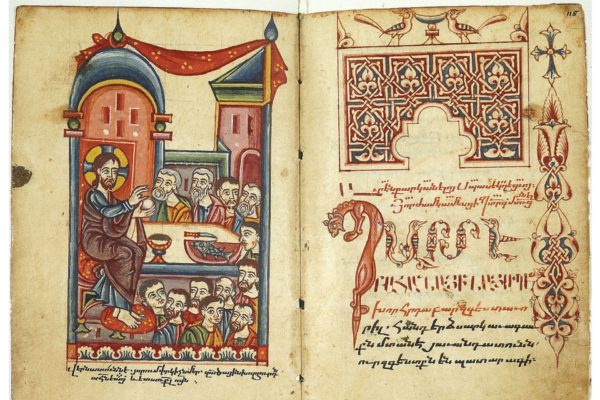
The Armenian Bible translation became celebrated as the "Queen of Translations."
As soon as the alphabet was ready in 405, Mashtots and his team:
- Translated the Bible into Armenian using the new script.
- Started teaching the alphabet in schools set up by Sahak Partev.
The Armenian Bible translation was so accurate and rich that it became famous as the "Queen of Translations." The new alphabet sparked a huge growth in literature, history, theology, and science. The 5th century is often called the "Golden Age of Armenian Literature."
Interesting facts and "secrets" about the alphabet
• Phonetic Precision
Each sound in Classical Armenian had its own letter. This made the script very efficient for reading and writing.
• National Identity
The alphabet became a core symbol of Armenian culture and identity, helping preserve the language through centuries of foreign rule.
• Numerical Use
Like Greek and Hebrew, Armenian letters were also used as numbers. People wrote dates and did calculations using the alphabet.
• Script Styles
Over time, scribes developed several main styles of writing: Erkat'agir ("iron writing") – the oldest, used in early manuscripts and inscriptions; Bolorgir – a rounded, later book hand that became dominant; Notrgir and Shghagir – faster, cursive styles used for notes and documents.
• Long Stability
The basic set of letters has remained almost unchanged since 405. Modern Armenian still uses the same core alphabet Mashtots designed.
Research and Debate
Scholars still discuss which older scripts influenced the shapes of the letters. Many think there was influence from Pahlavi (Middle Persian) and Aramaic, with some Greek features (especially for vowels and left-to-right direction). Some researchers even argue that many letter shapes were largely original creations by Mashtots, following his own design principles.