
Armenian Cultural Heritage
Matenadaran after Mesrop Mashtots
Yerevan Matenadaran — home to the largest collection of Armenian manuscripts in existence inscribed on the Memory of the World International Register by UNESCO.
Introduction
The Mesrop Mashtots Matenadaran in Yerevan is a museum, manuscript repository, and research institute. Its roots reach back to the Armenian alphabet’s creation in 405 AD and to the long tradition of writing, collecting and copying Armenian books at Etchmiadzin.
The present institution preserves the largest collection of Armenian manuscripts in existence and is recognized by UNESCO in the Memory of the World Register.
The Golden Age
The story begins in 405 AD, when Mesrop Mashtots created the Armenian alphabet with the support traditionally associated with Catholicos Sahak Partev and King Vramshapuh. The alphabet made it possible to write Armenian systematically and helped establish schools, translation work, and a new literary culture.
In the decades that followed, Armenian scholars translated the Bible and many religious, historical, philosophical, and scientific texts. Scribes copied these works by hand on parchment, while monasteries and church centers became places of teaching, writing, collecting and preserving books. This cultural flowering is commonly called the Armenian Golden Age.
Etchmiadzin and Medieval Life
The term matenadaran means a repository of manuscripts. Tradition connects the earliest Etchmiadzin repository with the fifth-century beginnings of Armenian writing. Over many centuries, Etchmiadzin and nearby monasteries copied manuscripts, received gifts, and brought together texts needed for worship, education, scholarship, and church administration.
A medieval manuscript was more than a text. It could be a Gospel book used in the liturgy, a teaching tool, a family offering, a legal record, or a carefully decorated object of devotion.
Copyists often left colophons—short notes at the end of books—naming the scribe, patron, place, date, and sometimes the hardship of producing or rescuing the manuscript. The collection’s survival was never guaranteed. Wars, forced migrations, fires, and plunder repeatedly damaged Armenian libraries. Yet manuscripts were also hidden, moved, redeemed, recopied, and donated, allowing a large body of written heritage to survive.
From Etchmiadzin to Yerevan
After Armenia was annexed to the Soviet Union, the Etchmiadzin manuscript repository was nationalized by decree on 17 December 1920. The manuscripts were then treated as state property, even though their history was closely tied to the Armenian Church.
In 1939, the collection was transferred from Etchmiadzin to Yerevan, where it was placed in the National Library. A separate institution and building were later created for it. Matenadaran’s modern research institute was established in 1959, and in 1962 it was named after Mesrop Mashtots.
The Soviet period changed the institution’s legal and administrative setting, but it also expanded professional cataloguing, conservation, publication, and scholarly study. Collections grew through transfers, purchases, and donations, including contributions from survivors of the Armenian Genocide living beyond the borders of Armenia.
The Yerevan Building
The main Matenadaran building stands on a hill at the northern end of Mashtots Avenue in Yerevan. It was designed by Mark Grigoryan (1900–1978), an outstanding Soviet Armenian architect, and completed in 1957. The building was conceived as a monumental home for manuscripts and scholarship. Its style is commonly described as neo-classical architecture. Grigoryan used local gray basalt, a severe symmetrical façade, a tall central arch, and forms that recall medieval Armenian churches and monastic buildings. The facade has been linked to the medieval architecture of Ani, especially the gavit of the Church of the Holy Apostles.
The building’s strong geometric mass and stone surface give it a fortress-like character. This visual language was appropriate for an institution understood as the guardian of a fragile written inheritance. A monumental statue of Mesrop Mashtots stands before the entrance, and sculptural figures of major Armenian writers and scholars reinforce the building’s cultural message.
UNESCO and World Culture
UNESCO inscribed the Mashtots Matenadaran Ancient Manuscripts Collection in its Memory of the World Register in 1997. The listing recognizes the collection’s importance not only for Armenian history but also for the documentary heritage of humanity.
The manuscripts cover theology, philosophy, history, law, medicine, mathematics, astronomy, geography, grammar, literature and the arts. Armenian translations are especially valuable because they sometimes preserve versions of Greek, Syriac, Arabic, Persian, and other works that are incomplete or lost in their original languages.
The Matenadaran therefore serves several roles at once: it is a national memory institution, a research center, a conservation laboratory, a museum, and an international source for the history of ideas, languages, art, and books.
Famous Manuscripts
- Vehamor Gospel: Generally presented as the oldest complete Armenian Gospel manuscript preserved today, usually dated to the 7th century. Its importance lies above all in its antiquity and in its witness to the earliest centuries of Armenian written Christianity.
- Lazarian Gospels: Dated 887, among the oldest dated Armenian Gospel books. Important for the history of the Armenian biblical text and early medieval Armenian book decoration.
- Etchmiadzin Gospels: Copied in 989 at Bgheno-Noravank in Syunik by the scribe Hovhannes. Famous for its Gospel text, miniatures, and carved ivory covers dating to the 6th century.
- Mughni Gospels: From the 11th century, widely admired for their elaborate miniatures and decoration. An important example of the rich, courtly side of Armenian illumination.
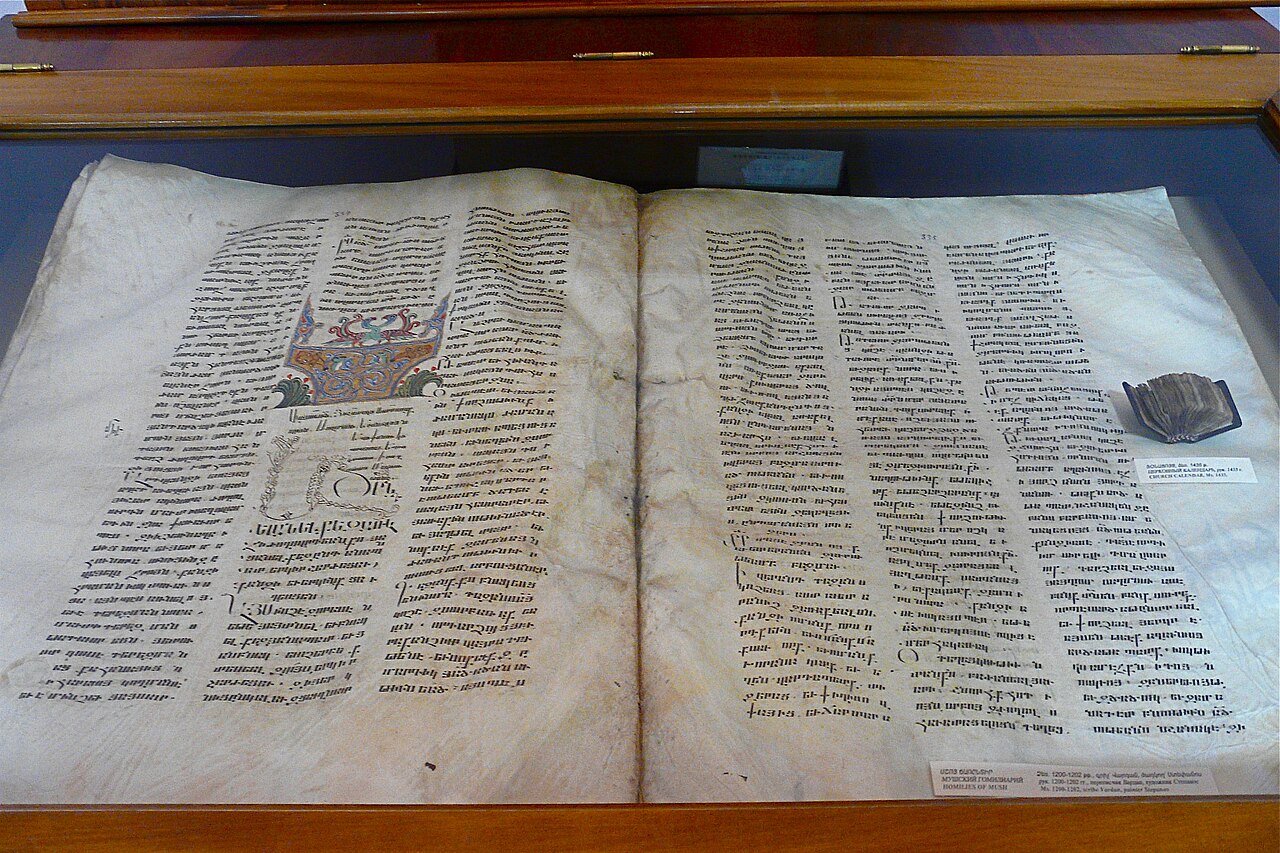
- Mush Homiliary (Msho Charentir): A huge 13th-century parchment book weighing about 27.5 kilograms. During the Armenian Genocide, it was divided into two parts to carry it to safety, and later reunited at the Matenadaran.
Medieval Manuscript Miniatures
Miniatures are painted images in handwritten books. In Armenian manuscripts, they may include portraits of evangelists, scenes from the life of Christ, saints, donor portraits, canon tables, decorated initials, marginal animals, plants, and ornamental frames. They are closely connected to the book’s text and religious use, not simply added as separate illustrations.
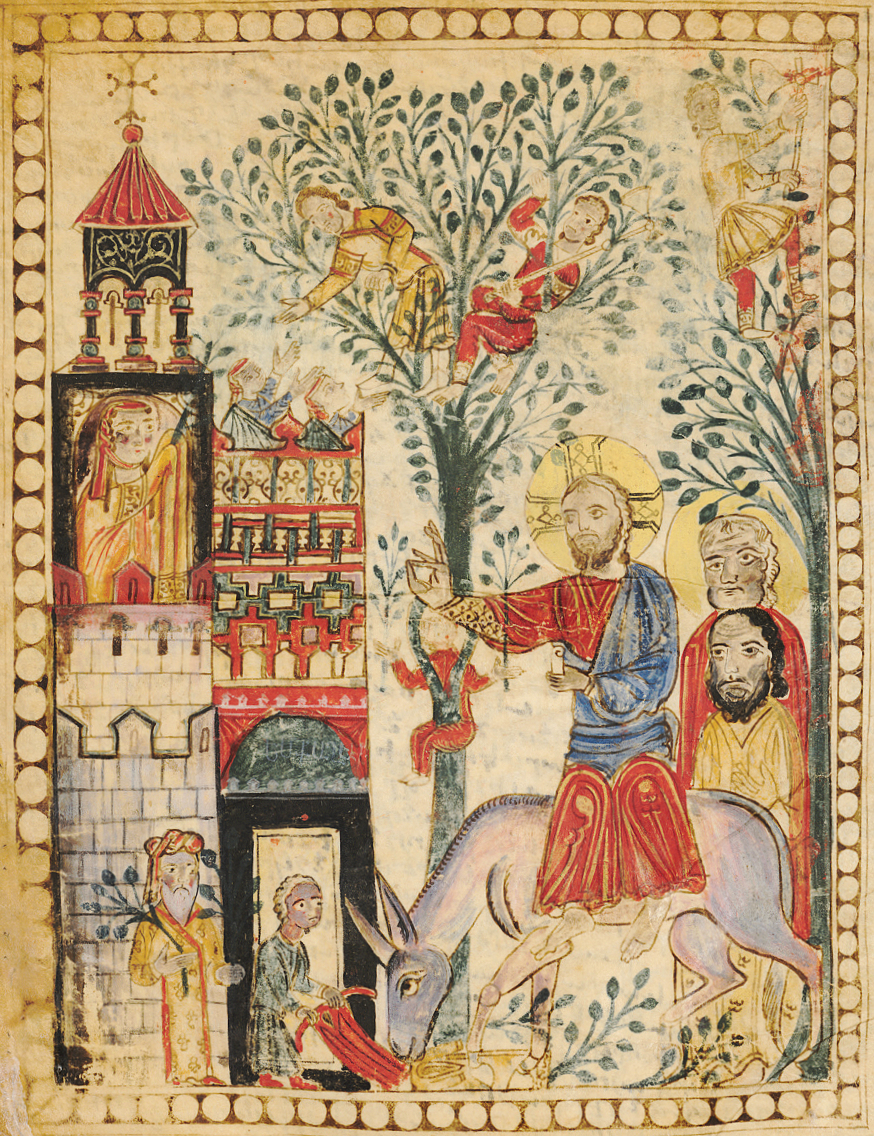
Early Armenian manuscript illumination often uses frontal figures, strong outlines, clear shapes, and little attempt at realistic depth. Instead of creating a lifelike three-dimensional world, artists emphasize spiritual presence, symbolic meaning, and readability.
- Canon tables: Decorative tables showing parallel passages among the four Gospels, framed by columns and arches.
- Evangelist portraits: Images of Matthew, Mark, Luke, and John placed near the beginning of Gospel books.
- Headpieces and initials: Ornamental designs introducing a new Gospel or chapter.
- Full-page miniatures: Larger painted scenes placed before or within the text.
Color, Gold, and Materials
Medieval artists worked on parchment made from animal skin. They used pigments from minerals, plants, and other materials, together with ink and gold leaf. Bright reds, blues, greens, and gold made Gospel books appear luminous in candlelight. Gold, especially, signaled holiness, honor, and visual richness.
Regional Schools of Illumination
Vaspurakan School
Connected with Lake Van and centers like Khizan, valued for its narrative force and symbolic clarity. Artists used stylized forms, strong contours, large eyes, and direct gestures.
Cilician School
In the Armenian Kingdom of Cilicia (12th–14th centuries), manuscript painting reached a highly refined form with detailed architecture, nuanced faces, and assured use of gold.
Artsakh and Other Regions
The Gospel of Vakhtang Khachentsi (Gandzasar, 1212) stands as the earliest surviving illuminated manuscript from Artsakh-Utik, proving that Armenian manuscript painting flourished across many regional centers.
Why the Miniatures Matter
Armenian miniatures preserve a long visual tradition linking late antiquity, medieval Christianity, the Caucasus, Byzantium, the Islamic world, and the eastern Mediterranean. They serve as historical evidence showing clothing, architectural ideas, devotional practices, and international cultural contacts.
For the Matenadaran, these miniatures are inseparable from the manuscripts that carry them — representing a unique union of text, handwriting, art, and human memory.